Thursday, October 8, 2015

vCenter Server 5.5 installation/upgrade stuck at Orchestrator installation screen

Last day when I was re-installing vCenter server in our test environment, came across this issue where vCenter install process stuck at Orchestrator installation screen for indefinite time (waited for around two hour). 
Initially I thought there might be something wrong with my machine as I had not rebooted the system after vCenter uninstall so I clicked on cancel to end the installation without success then I had to kill the installation process from task manager.
Once the installation terminated, I uninstalled the SSO, inventory service and Orchestrator (yes it was there in add remove program) and rebooted the system. After reboot installed SSO, inventory service and then initiated the vCenter installation again but to my surprise, vCenter installation stuck on same Installing Orchestrator screen again. Then I started Googling about this issue and found a VMware KB article about the same.
As per KB# 2051216,

This is a known issue affecting vCenter Server 5.1 Update 1 and vCenter Server 5.5

To work around this issue:
  1. In the Windows Task Manager, locate the vRealize Orchestrator (formerly known as VMware vCenter Orchestrator) processes. For example, you may see processes similar to:

    vCenterOrchestrator.exe *32 InstallAnywhere Self-Extractor
    vCenterOrchestrator.exe *32 LaunchAnywhere
  2. End the process tree for the vCenterOrchestrator.exe *32 LaunchAnywhere process.

    The vCenter Server installer should now complete successfully.
Note: If you are a user of vRealize Orchestrator (formerly known as VMware vCenter Orchestrator), you can complete the configuration manually through the vRealize Orchestrator configuration service.

Related KB article# 2045613.

That's it... :)


Sunday, October 4, 2015

Looking up MoRef (Managed Object Reference) IDs in vSphere environment

Today I saw a question about VM MOID like how to get it. The answer could be pretty simple like using RVTools,
But what are the other ways, before talking about that, first understand what this MoRef ID is. Every object within a vSphere environment is internally tracked, and has a unique identifier called moRef ID. A Managed Object Reference ID also known just as MoRef ID is a unique value that is generated by the vCenter Server and is guaranteed to be unique for a given entity in a single vCenter instance.
This identifier is composed of a prefix stating the object type, followed by a numerical ID, for example:

host-25
vm-11
datastore-09   etc.

You can check the MoRef ID of a host by going to this URL:
https://vC_Server FQDN_or_IP/vod/index.html


Now we will look up the specified moRef ID using Managed Object Browser it will show you the corresponding object with all its properties, including its name of course.for other objects. Go to https://vC_Server FQDN_or_IP/mob/?moid=host-id


From here you will get the MoRef IDs of other objects and can get further detail about the by using managed object browser.

To check moRef IDs using PowerCLI, for this connect to your vCenetr or a host using using the Connect-VIServer cmdlet,
Connect-VIServer <vcenter_or_host> -User uaser_name -Password *****

After you have successfully connected, the Get-<object_type> cmdlets allow you to know which object has a particular MoRef ID in no time,
Get-VMHost | ft -Property Name, ID


The “ID” field returned by PowerCLI is actually the moRef, preceded by a slightly more “verbose” string stating the object type.
Replace Get-VMHost with  Get-VM or Get-Datastore to carry out equivalent operations on other object types

You can always search for a specific ID, just be sure to add an asterisk (*) before the moRef ID you are looking for so you don’t have to include the object type string every time.
Get-VM -ID *moRef_id | ft -Property Name,ID                                        or
Get-Datastore -ID *moRef_id | ft -Property Name,ID -AutoSize

Reference: Danilo Chiavari and William Lam's blog posts.

That's it... :)


Tuesday, September 29, 2015

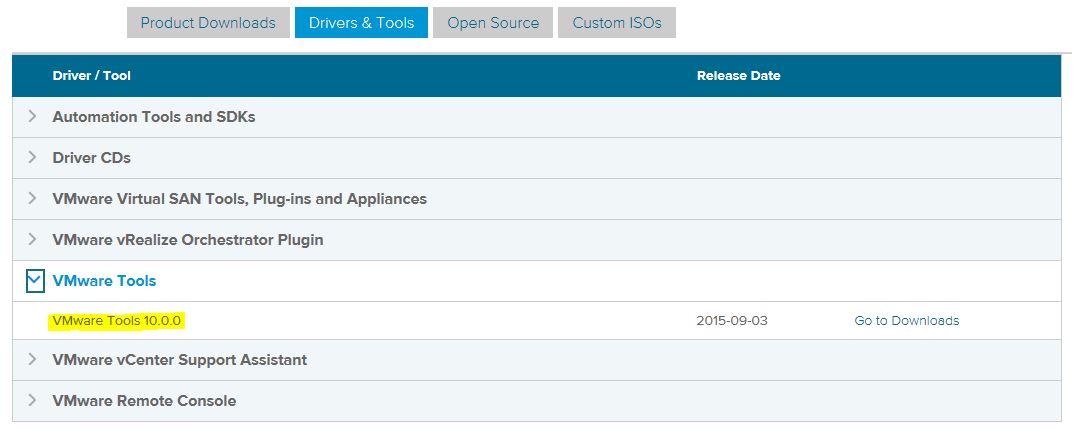
VMware tools 10.0.0 released and in future it would be a separate release

With the separate release of VMware tools 10.0.0 now VMware made clear, VMware Tools release is no more tied with vSphere release/Esxi builds. I think this is the first time when VMware released VMware Tools separately. As per release note its backward compatible, compatible with Esxi 5.0 and also compatible with Workstation 12.0 and VMware Fusion 8.0.

As per VMware it will allow to get the latest new features and enhancements made to the VMware tools faster to the customers. And that there is no specific reason not to do so.

You can download and install the latest version of VMware Tools from Here,

 
Yes, VMware now also including release notes specific to VMware Tools. This will allow one to see what’s new in each release, along with compatibility, installation/upgrade information etc.

Full release notes is available Here,

Reference: Brian Graf's blog Post on VMware Blog.


That's it... :)


Saturday, September 19, 2015

How to fix Configuration issue: Unable to apply DRS resource settings on host

Last day when I was looking At my vCenter instance, found two hosts with read explanation mark on them and when checked found this configuration issue related message in summary: “Unable to apply resource settings on host. The available CPU resources in the parent resource pool are in sufficient for the operation. This can significantly reduce the effectiveness of DRS.”

Interestingly DRS is not enabled for the cluster where these hosts are located so what is the cause of this error (you may also see this kind of configuration issue message on host in a DRS enabled cluster).
When I was looking for the reason of the same, found resource reservations configured for most of the VMs in this four host cluster. I had seen this error earlier and that time was able to fix it by offloading some VMs from that host to another however this time that didn’t work and even another host started showing the same configuration issue then I tried to remove reservation but that also didn’t work.
Note: If there are enough resources available in the cluster then you may safely ignore this configuration error message. 

These are the potential fixes of above configuration error:
In order to remove this configuration error message what we can do is, first enable DRS on this cluster (if already enabled, disable it and then re-enable) and leave it for some time (if you don’t want to leave it then you may run DRS manually), if you are lucky then this would fix this the issue.

An unfinished VMware tools installation (where you initiated tools installation but it never finished) also could be a reason of this configuration issue. If that is the case, Mark that by right clicking on it => Guest => End VMware Tools Install. It will resolve the issue and the error will disappear.

If that doesn’t work then in order to fix this you will have to restart management agents on affected servers (restart the hostd and vpxa agents). After restarting the management agents this configuration issue related message will go away.

For detailed info refer to VMware KB# 10283511004667

If you have seen this configuration issue before and fixed it using any other way, please share in comment area.

That's it.... :)


Thursday, September 17, 2015

How to Speed-up P2V conversion process: disabling SSL etc

It’s a long time since I have not done any physical to virtual conversion myself so was not aware about this, starting with VMware vCenter Converter Standalone 5.x, during P2V conversion the converter encrypts the data using SSL. Encrypting the traffic increases the security, but it may decrease the performance. For a small server you may not notice this but if you are doing P2V of a physical server that have a large drive attached then you will see a long estimation time.

First thing first, to speed-up conversion process disable SSL encryption in VMware vCenter Converter Standalone. This involves editing one xml file on the physical machine being converted, to avoid SSL related slowdown, takes about a minute to do but would significantly reduce the P2V conversion time.
To disable SSL for vCenter Converter, as per your Windows OS version go to following location:

In Windows 7/Server 2008 and Later : C:\ProgramData\VMware\VMware vCenter Converter Standalone

In Windows Vista, XP and 2003 Server: %ALLUSERSPROFILE%\VMware\VMware vCenter Converter Standalone

In older Windows versions: %ALLUSERSPROFILE%\Application Data\VMware\VMware vCenter Converter Standalone

  • Locate the converter-worker.xml file in VMware vCenter Converter Standalone foder, first take backup of this file(just in case something goes wrong) and then open it with any text editor like Notepad
  • Now locate the tag pair <useSsl></useSsl>. It is located inside the <nfc> tag and has a value of true. 
  • Change the value from true to false, Save and close the file.

  • Restart the VMware vCenter Converter Standalone Worker service on the machine.
After disabling the encryption you would immediately saw dramatically reduced estimated times to completion.

Another thing that you can be do to speed-up P2V process is, you can increase the value in the Number of Data Connections per Task option in Converter settings. If you are converting the source with multiple disks and volumes, it would decrease the conversion time by cloning multiple disks and volumes concurrently.
To do this, In the Converter GUI main menu, select Administration > Data Connections per Task to modify the settings.

Cloning too many volumes from the same source disk in parallel can increase disk access times and consequently increase conversion time.

Also take care of other P2V pre-conversion best practices.

Reference: VMware KB# 2071014  

That’s it… :)


Wednesday, September 9, 2015

How to prepare a VM with Sysprep before converting it to Template

During VM deployment I saw it many times where people don't run VM customization wizard during deployment and later faces duplicate SID issues.

To ensure not to face duplicate SID issue, its better to prepare the OS using Sysprep before converting it to Template.

Prior to converting a VM to Template, just remember to use Sysprep as follows,
  • Run Sysprep, C:\Windows\System32\Sysprep\Sysprep.exe
  • Ensure ‘System Out-of-Box Experience (OOBE)’ is selected  and Tick the ‘Generalize’ option and Select ‘Shutdown’ from the Shutdown Options. 

(You can do the same in one go using this command "C:\Windows\System32\sysprep\sysprep /oobe /generalize /shutdown")
Once the machine has shutdown, convert it to Template/Image or Clone and you are good to go!

This will trigger sysprep procces inside newly deployed VM after its first Power On.

Note: Yes during VM deployment, Sysprep will come to the picture right at the VM deployment phase where you have 3 options: 

  • Do not customize
  • Customize using the Customization Wizard 
  • Customize using an existing customization specification 
If you had already prepared the template VM with Sysprep the you can choose Do not customize  here.

You may take a look here for related post : how-to-fix-issue-of-duplicate-sid

That's it.... :)


Where to look for Interoperability/Compatibility of different VMware products

Did you ever find yourself in a situation where you wanted to figure out about compatibility of a VMware product with other products. Below listed links are the best place to look in such kind of situation,

VMware Product Compatibility Guide
Useful to obtain compatibility information.


In this image highlighted Compatibility Guide dropdown is very useful, when you would click on it, 

 VMware Product Interoperability Matrixes site
To obtain information on interoperability between VMware products with each other.


Supported Guest and Host Operating Systems
The Guest/Host OS tab on the VMware Compatibility Guide Web site lists supported guest and host operating systems and provides related support information.

GuestOSCustomizationSupportMatrix
Here you will find information about Guest OS Customization support in vCenter for various OS
releases.

Guest OS Compatibility Guide
TheVMware Compatibility Guide shows the certification status of operating system releases for use as a Guest OS by various Esxi/Esx, Workstation, Fusion, VMware ACE etc.

 Referance: http://www.vmware.com/guides.html

That's it.... :)


Thursday, September 3, 2015

Newly built VM and network connectivity issue

Today I came across a very strange issue where a newly built MS Server 2012 virtual machine was dropping network connectivity. This VM was build using MS server 2012 R2 Standard ISO instead of our regular template so after VM creation we installed VMware tools, rebooted and then configured IP address on it. Initially it was showing network connectivity so enabled RDP, disabled firewall and then tried to take this machine on remote but couldn't connect and when I tried to ping, it was not reachable.

Then I logged in to the VM via console and noticed the NIC was showing limited connectivity so I checked the IP configuration, everything was ok. In order to troubleshoot the issue I removed the IP and selected DHCP and then again gave the same IP, VM came in network for few seconds the again limited connectivity. Initially I thought the problem is with the VM NIC so removed the old vNIC and then added a new VMXNET3 vNIC from VM settings (how funny, I did that like its a physical host/network card) but still had the same issue.

So what's the issue here, initially I didn't check the VMware tools as this was a newly build server and I had already installed VMware Tools on it but later on after wasting around 30 minutes I find out somehow VMware tools got corrupted (as e1000 vNIC had no connectivity issue that means issue was with VMXNET3 driver and it comes with VMware Tools) so by repairing the tools installation I was able to fix this network connectivity issue.


After VMware Tools repair VM didn't prompt for reboot and as soon as tools repair completed, VM network connectivity restored.

That’s it…. :)